Why .locker is the Natural Home for AI Agent Identity

By Don Ruiz, Orange Domains' General Manager
The Trust Problem No One Solved Yet
Every transformative shift in computing has required a new identity layer. The web needed usernames and passwords. Mobile needed OAuth. The cloud needed IAM roles. Now agentic AI, systems where autonomous software acts on behalf of humans, needs its own identity primitive.
The question is simple and urgent: when an AI agent initiates a transaction, signs a document, or requests access to your systems, how do you verify it? Who is it? Who authorized it? Can you audit what it did?
Right now, there is no universally accepted answer. That gap is exactly where .locker sits.
“The hardest problem in multi-agent AI is not intelligence. It is trust. And trust requires identity.”
DNS: The One Protocol Every AI Already Speaks
Before proposing a solution, you have to ask: what is the right substrate for agent identity? Blockchain wallets? Proprietary credentialing systems? Platform-specific tokens?
The answer is simpler and more powerful than any of those: DNS. Domain names are the internet’s oldest and most universally supported identity primitive. Every server, every API, every firewall on the planet already resolves them. They are human-readable, cryptographically securable via DNSSEC, and stack-agnostic by design.
An AI agent built on OpenAI, Anthropic, Google, or any open-source framework can be assigned a .locker identity without a single platform-specific integration. It just works, because DNS already works everywhere.
- DNSSEC verified: cryptographically secure by design
- Stack-agnostic: works across any AI framework
- Human-readable: no wallet addresses or opaque tokens
- No blockchain required: zero friction for enterprise adoption
- No vendor lock-in: open, interoperable standard
Know Your Agent: The Compliance Layer Enterprises Need
Regulated industries in finance, healthcare, and legal are already wrestling with a new class of audit question: what did our AI agents do, on whose behalf, and with what authorization? The Know Your Agent (KYA) framework maps directly to that compliance surface. Every .locker agent identity answers four foundational questions:
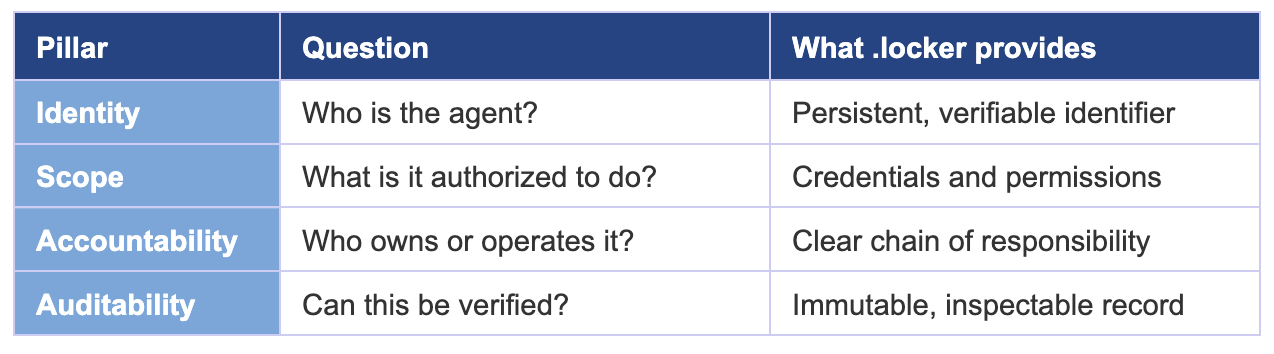
This is not speculative compliance theatre. Enterprises deploying agentic AI in 2026 are already asking these questions and finding no satisfying answers in existing tooling. KYA using .locker’s DNS + digital identity is designed to be that answer.
The Brand Fits the Moment
Naming matters more than people admit. “Locker” carries exactly the right semantic weight for AI agent identity: a secured container for credentials, authorizations, and identity attributes. It is controlled access. Can utilize scoped permissions. A revocable key to a bounded set of capabilities.
An agent’s .locker domain is its digital credential wallet, not a vanity address, but a functional identity anchored to the DNS. The name does the work before a single word of explanation is needed.
Multi-Agent Systems Amplify the Need
The identity challenge compounds when agents talk to other agents, which is already standard in agentic workflows. Agent A needs to verify Agent B before accepting its output, delegating a subtask, or granting resource access.
Without a shared identity fabric, every multi-agent system has to solve this problem from scratch. A .locker namespace creates interoperable trust infrastructure that works across systems, vendors, and organizations without requiring any central authority to mediate.
A First-Mover Window That Won’t Stay Open
AI agent frameworks such as LangChain, AutoGen, CrewAI, and OpenAI’s Assistants API are proliferating at extraordinary speed. But agent identity standards are still wide open. There is no dominant protocol, no entrenched namespace, no established convention.
.locker has an opportunity to become a TLD for agent identity the way .io became the default for developer tools, or .ai became shorthand for the industry itself. Neither outcome was declared in advance. They emerged because an early player occupied the right space at the right moment.
That moment, for agent identity, is now.
.locker is the domain layer for AI agent identity, where agents get their credentials, prove their authorization, and build verifiable trust across any system. The namespace is open. The infrastructure is ready. The moment is here.
To learn more about .locker, contact Don Ruiz or visit my.locker.
The $320B Stablecoin Market Needs an Identity Layer
Stablecoins hit $320B, but wallet addresses still can't tell you who you're paying. See how .locker adds a human-readable onchain identity layer to crypto payments.
September 30, 2026